Artists Included::
Mark Beasley
Michelle Ceja
Anton Gerasimenko
Jan Robert Leegte
Sara Ludy
Miltos Manetas
Duncan Malashock
Nicolas Sassoon
Rick Silva
Pascual Sisto
Kate Steciw
Jenneifer Steinkamp
---
For me the Internet has always been a physical space. Working as a sculptor, the first moment I started experimenting with HTML code and viewed the results in the browser, I witnessed a physical installation.
-Jan Robert Leegte talking to cont3xt.net1
A reoccurring trend I've observed that is currently unfolding within an emerging generation of net based artists (and artists that make what is termed "net aware" art) revolves around concerns of landscape and architecture within digital network culture. The translation of landscape studies onto net based art works operates both as a continuation of a tradition, and as a reconciliation between that which is "real" and that which is "virtual." However, this binary is becoming harder to distinguish as artists today are finding more elegant models for marrying spaces that were once thought of as being in diametric opposition.
Paul D. Miller determines that to invest ones practice in digital frameworks is to "try to make a bridge between the interior and exterior."2 Not only is Miller's vernacular here of particular interest - using a "man-made" object to determine spatial distance/separation - but his suggestion that one of the only possible ways to mediate the separation of self to land is to delve into the digital is also directly in dialog with the methodologies of the artists included in this exhibition.
Notes on a New Nature derives its name from a lecture that I gave at The School of the Art Institute of Chicago concerning what I considered a growing tendency of a artist working on (or around) the web. In my thesis for my talk, I argued that the terms and devices that contemporary net artists were employing are not all that dissimilar to the concerns expressed by early Modernist painters like Cezanne. Works like Mont Sainte-Victoire (1905) illustrate a desire in Cezanne to capture what one could now term to be the "virtual" qualities of the French country-side; namely how representation of space cannot rely on duplication alone.
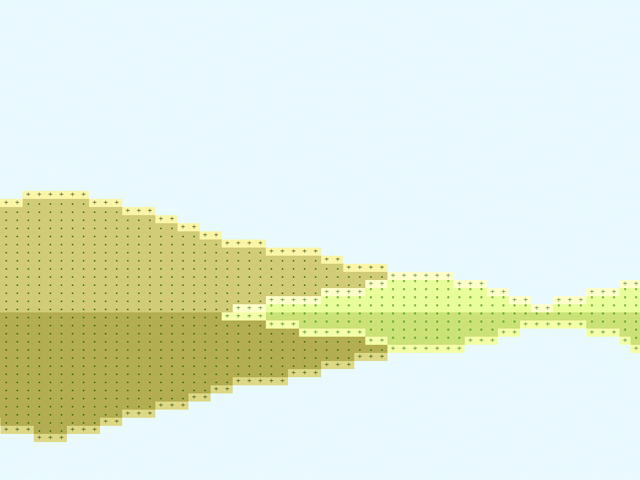
The methods that each artist employs within this exhibition take different measures toward considering how digital technology and gadget culture have affected how we represent our relationship to land. Mark Beasley and Anton Gerasimenko both outfit the land with a sense of operation and interface by having elements of the browser dictate the shape and formation of their representations. Similarly, Jan Robert Leegte's work places the visual vernacular of the browser as a focal point to discuss how we view space off of the screen.
Although the code and the screen play a large role in how these artists engage with expanding our notions of space and landscape, artists like Miltos Manetas and Pascual Sisto take a less circuitous route in their reconfiguring of the history of representing land. In a certain way, Manetas and Sisto challenge the notion of the landscape as a space that is identified not by its being, but through its representation. In other words, landscape - as a specific geographic term, and also as a metaphorical device - is only formed when it has been put within a frame.3 In Painting with Nature, Manetas uses the POV of the artist to illustrate the immediate artifice that occurs when looking at petals of leaves out a studio window; our vision of the world has already been compromised by our inherent willingness to attach the sight of nature to its art historical representation. Sisto in turn acknowledges this inhibition by deliberately taking the familiar moon and turning it into a set of eyes; now the heavens look down at us, returning the gaze that has been imbued in us since birth.
Rick Silva and Jennifer Steinkamp provide views of computer generated land being manipulated within a given axis of three dimensional space. By making clear these operations within a given simulated space, one begins to expand how we typically frame and similarly organize space in other types of representation (map-making can be a rudimentary example). Likewise, Duncan Malashock uses a color gradient similar to a sunset to illustrate a artificial depth on an otherwise shallow z-axis. In doing so, Malashock invites viewers to delve into a kind of idealized platonic space where rectangles and puzzles - or one could read them as magnified pixels - go to dance.
Another approach that specifically deals with the materials found within the history of representing land can be found in the methods that Kate Sticew and Michelle Ceja employ. Steciw specifically references how the rhetoric of conventional photography can be reorganized to include and interpret three and four dimensional space.4 By asking viewers to reconsider how one views imagery in their everyday environment, Steciw wants to position what would typically be considered a "mundane" object/subject - landscape - into a realm where it can maintain relevance against a mass media backdrop. Ceja applies a combination of found and arrange set pieces that create a similar questioning of imagery used to depict space. Instead of using the medium of photography, Ceja expands into the physical setting of the gallery, creating a composition out of nature containers like fish tanks and house plants that reference how we interface with land on a domestic level.
Where Steciw and Ceja opt for a symbolic understanding of the nature that abstracts the texture of landscape into a cultural object, Sara Ludy and Nicolas Sassoon instead decide to explore the "neutral space" of land to decode how architecture plays a role in "uncovering the meanings potentially present in the given environment."5 Within these two practices we observe both ends of a spectrum; on one end Ludy explores the body, on the other Sassoon examines the home. As in all spectrums, the furthest poles start to eventually fold back into other. In this sense, one can observe how our first sense of home is through the understanding of our body. In her piece Body Wave, Ludy marries the visual rhythms that resonate between the small of our backs and the roof of the world's mountain ranges. On the opposite side of the same coin, Sassoon constructs lo-fi 3D animations of domiciles that reflect a aesthetic sensibility that would appeal to both Buckminster Fuller and players of 8-bit video games. Even if the surveying method of landscapes might vary between Ludy and Sassoon, they both attempt to shape our notions of land and its associations through the mediation of what Edward Soja might call the Thirdspace; a lived/social space that we occupy that is the "place where all place are," in an "all-inlcusive simultaneity."6
---
Notes::
1 http://cont3xt.net/blog/?p=3533
2 Miller, Paul D. Rhythm Science. New York: Meidawork/MIT Press. 2004.
3 Corner, James, Ed. Recovering Landscape: Essays in Contemporary Landscape Architecture. New York: Princeton Architectural Press. 1999
4 http://thestate.tumblr.com/tagged/Kate+Steciw.
5 Norberg-Shulz, Christian. Genius Loci: Towards a Phenomenology of Architecture. New York: Rizzoli, 1980.
6 Soja, Edward W. Thirdspace: Journeys to Los Angeles and Other Real-and-Imagined Places. London: Blackwell. 1996